

Arkansas Commercial Real Estate in 2026: What the Numbers Are Actually Telling Us
National headlines about commercial real estate tend to tell one story. The Arkansas market is telling another. While cooling trends and office vacancies dominate the broader conversation, the data coming out of Northwest Arkansas, Central Arkansas and Jonesboro points to something more interesting — a market defined by real demand, low industrial vacancy and a capital environment that's starting to move again. Here's a closer look at what's happening on the ground, and why it matters if you're investing in Arkansas commercial real estate in 2026.
Arkansas 2026: Market Dive
1. Northwest Arkansas (NWA): Supply vs. Demand
The Arvest Skyline Report (March 24, 2026), authored by researchers at the University of Arkansas Center for Business and Economic Research (CBER), confirms that NWA is defying national cooling trends.
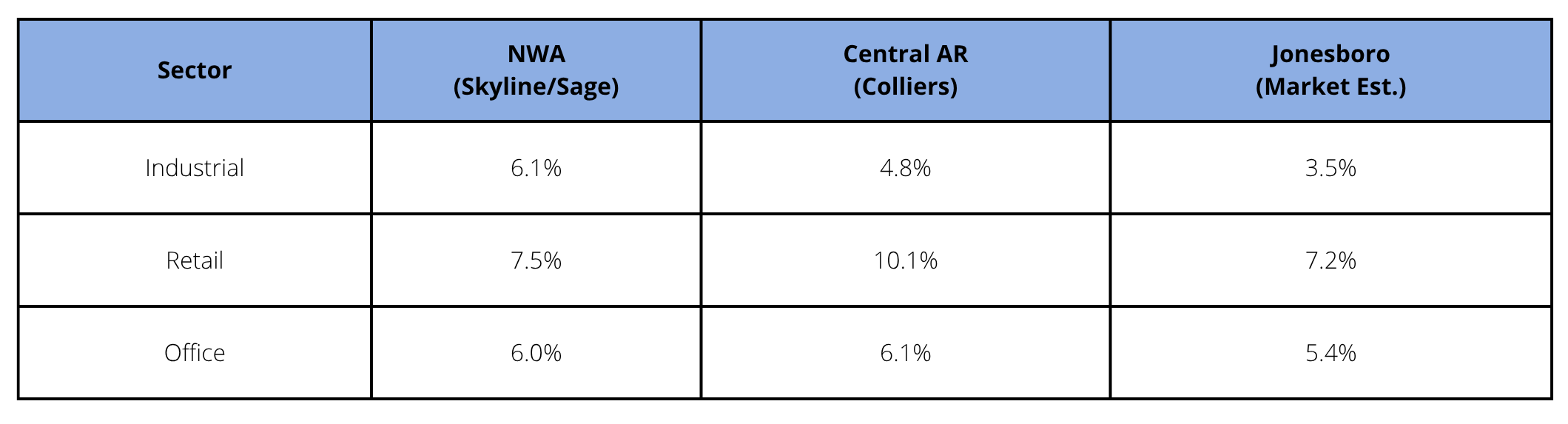
Overall Vacancy: Dropped to 6.3% in H2 2025/2026, down from 7.2% in the first half of 2025.
Warehouse Vacancy: Fell sharply to 6.1%.
Retail Vacancy: Dropped to 6.0%.
Office Vacancy: Rose slightly to 7.5%, which researchers attribute to 123,565 square feet of new and previously owner-occupied space entering the market.
“In the second half of 2025, we saw... the overall vacancy rate drop, a clear sign of strong demand.” — Mervin Jebaraj, Director of CBER.
Marshall Saviers, CEO of Cushman & Wakefield | Sage Partners, emphasizes that the “supply-side issue” is the main hurdle for the region's continued industrial expansion.
2. Central Arkansas: Stabilization & Flex Dominance
Central Arkansas entered 2026 with a “Great Basis Reset,” where property values adjusted to the new interest rate environment, spurring transactions.
Office Vacancy: Hovering near 10.1%. Colliers Central Arkansas notes that the “Flight to Quality” is real, with Class A office space outperforming older stock.
Industrial Vacancy: Remains historically low at 4.8%.
“We are seeing a resurgence in owner-user demand for flex buildings in the 15,000 to 20,000 square foot range.” — Brandon Rogers, Principal at Colliers Central Arkansas.
3. Jonesboro: The Regional Stronghold
Jonesboro enters 2026 as a premier “secondary growth hub,” a designation supported by CBRE’s 2026 U.S. National Outlook. The city’s immunity to the volatility seen in larger metros is largely due to its specialized industry clusters in medical services, Ag-Tech, and e-commerce logistics.
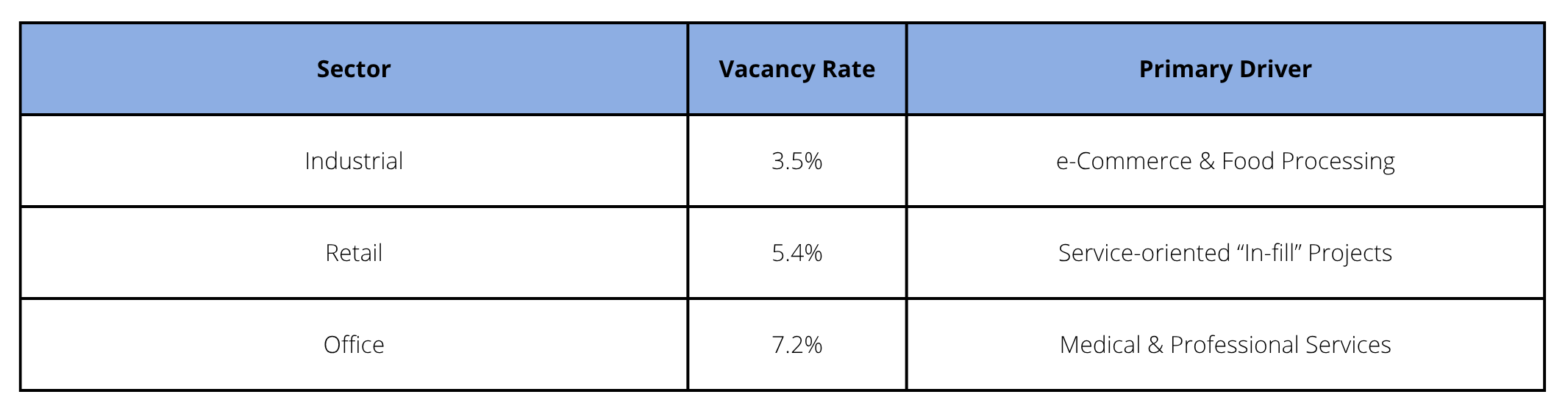
Industrial (3.5%): The region is seeing a significant expansion in high-clearance warehouse demand. Joshua Brown, Co-founder of Haag Brown Commercial, notes that the city's strategic focus on infrastructure is paying off. “We are seeing a shift where mobility and connectivity are the new currency for the markets we serve across Arkansas, and Jonesboro is positioned perfectly as a logistics anchor.” — Joshua Brown, Haag Brown Commercial.
Retail & Mixed-Use (5.4%): Activity remains concentrated in the Hilltop and Red Wolf Boulevard corridors, with a new emphasis on “verticality” and density to maximize existing infrastructure.
Office (7.2%): The market is shifting away from traditional low-rise layouts toward more integrated, professional environments. Jerry Halsey Jr., of Halsey Real Estate, sees 2026 as the beginning of a “next decade of growth” for Jonesboro’s urban core.
“This era signifies a strategic shift in our focus toward excellence and growth. As we look at Jonesboro's next decade, we are committed to projects that emphasize quality of life and density, helping the city grow ‘upward and inward’ rather than just outward.” — Jerry Halsey Jr., Halsey Real Estate.
Market Insight: Per CBRE, Jonesboro is benefiting from “sticky” occupancy. Unlike Tier 1 metros, where tenants are downsizing, Jonesboro’s medical and industrial users are often owner-occupants or long-term leaseholders, providing a buffer against national economic shifts.
Quick Stats: Northeast Arkansas (Jonesboro) 2026
2026 National Macro-Trends: The Experts
To understand why Arkansas is outperforming, it helps to zoom out. The macro environment shaping commercial real estate in 2026 — interest rates, capital deployment, productivity growth — sets the context for what's happening at the local level. Here's how some of the sharpest minds in global finance are reading the moment.
J.P. Morgan: The Transactional Rebound
Michelle Herrick, Head of Commercial Real Estate at J.P. Morgan, is optimistic about the capital markets this year.
“The 2026 market is strong from both a capital and fundamental standpoint — we anticipate more transactions in the coming year.” — Michelle Herrick, J.P. Morgan (2026 Outlook).
Cohen & Steers: The Data Center Pivot
Their 2026 research highlights that Data Centers and Industrial are the “secular winners.” They warn that traditional office space is still in a “structural transition,” but identify high-growth regions, such as NWA, as the primary areas where private equity will deploy capital in 2026.
KKR Global Perspectives: The Productivity Miracle
Henry McVey, KKR’s Head of Global Macro, suggests in his 2026 Outlook that “productivity is the quiet force” powering the current expansion. KKR believes that 2026 is the year to shift toward “Asset-Based Finance” and real estate credit, as inflation settles into a “resting heart rate” of roughly 2.5%.
Howard Marks (Oaktree Capital): The Value-Price Magnet
In his recent 2026 memo, The Calculus of Value, Marks reminds investors that “value exerts a magnetic influence on price.” He suggests that the 2026 market is moving away from the “froth” of speculative tech and back toward properties with durable, cash-flowing fundamentals — and this is what is being seen in Arkansas’ industrial and retail sectors.
Goldman Sachs: Sturdy Global Growth
Goldman Sachs Research projects a 2.8% global growth rate for 2026, with the U.S. likely to outperform due to easier financial conditions. This macro-tailwind supports the “cautious development” seen in Arkansas; while building permits fell in late 2025, the underlying economy remains strong enough to absorb existing vacancy.
Summary of 2026 Arkansas Vacancy Stats
Sources Cited:
Arvest Skyline Report H2 2025/2026 (Published March 2026).
Colliers Central Arkansas Q1 2026 Internal Market Review.
J.P. Morgan: “2026 Commercial Real Estate Trends” (Michelle Herrick).
KKR: “Outlook for 2026: The World Has Changed.”
Howard Marks: “The Calculus of Value” (April 2026).
Goldman Sachs: “Macro Outlook 2026: Sturdy Growth.”